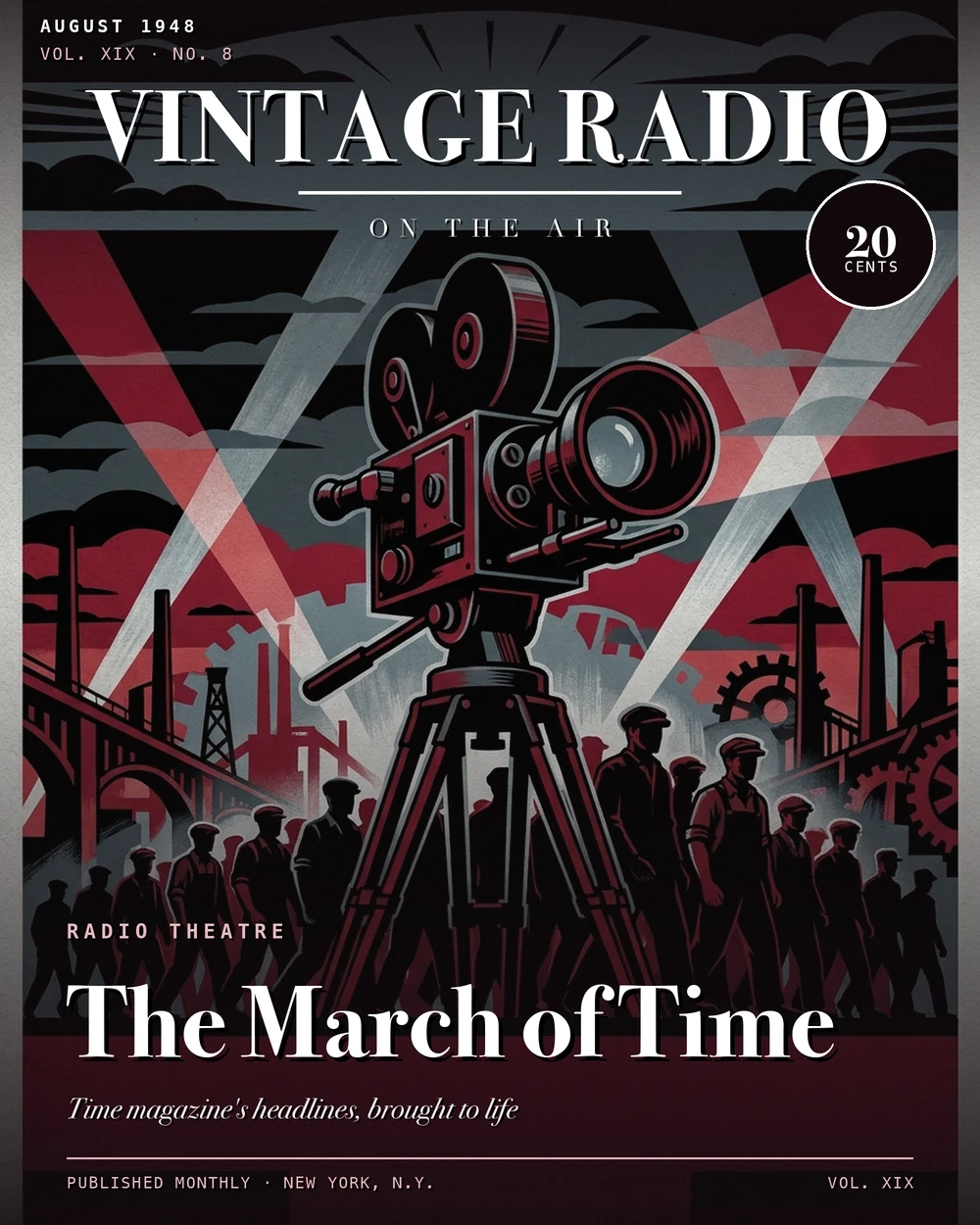
The March of Time
What It Was and Why Nothing Like It Had Existed Before
The March of Time did something radio had never attempted at scale: it dramatized the news. Not commentary, not a newsreader reciting headlines, but a full theatrical production — actors impersonating living world leaders, elaborate sound effects, a full orchestra, and scripts assembled on a Sunday-to-Friday grind to match whatever was breaking in the world. When the show premiered on a partial CBS hookup of 32 stations on March 6, 1931, at 10:30 p.m. Eastern, it introduced what contemporaries quickly called the first radio newsreel, and nothing on the air quite resembled it before or after.
The roots stretched back to 1928, when Fred Smith, the station manager at WLW in Cincinnati, conceived a ten-minute newscasting format partly to get around a practical problem: wire services in those years limited their clientele to print outlets, leaving radio stations with almost no access to professional news gathering. Smith approached Roy Larsen, who handled circulation for Time magazine out of Cleveland offices. Larsen obtained permission to use Time's material, and on September 3, 1928, Time began syndicating scripts to other stations. By September 1929, full shows were being transcribed and mailed to subscribers, and soon more than 100 stations were carrying the syndicated version.
A closed-circuit audition was prepared and performed on February 6, 1931, for CBS executives and the editors of Time. The broadcast went directly to Larsen's home, where CBS chief William S. Paley and Time publisher Henry R. Luce were both present, according to Raymond Fielding's book The March of Time. Almost nobody in the room liked what they heard. Luce remained uneasy about what he felt was the show's bellicose character — too much like a midway barker hawking news — and many Time editors stayed skeptical long after the show caught on with critics and the public. Larsen himself worried about the legality of impersonating living people in a format that audiences might take as authentic news. Smith's counterargument was that the show would treat only verifiable facts and put no words in anyone's mouth that they hadn't actually said. Plans went forward regardless.
Variety's review of the premiere, published March 11, 1931, was favorable. The trade paper noted that the show's manner of enacting "memorable" scenes might make the program "within a short period of time one of the most popular on the air … Everything was highly effective, colorful and smartly presented." The magazine had it roughly right.
The Sound and How It Was Made
Smith's original formula called for "the 10 best radio actors," "an announcer extraordinary," "a splendid orchestra," and "a clever director." The show that came out the other end of that process sounded, to contemporary ears, like an authentic Movietone newsreel — shouting mobs, riveting sound effects, music building to a relentless pace. Every week, seven or eight sketches ranging from 90 seconds to four minutes were fitted together like the sections of a newspaper assembled against deadline.
Scripts were written from Sunday through Wednesday. On Wednesday, producer-director Arthur Pryor Jr. — who ran the show for the advertising agency Batten, Barton, Durstine and Osborne, which handled Time's account — met with orchestra leader Howard Barlow and sound artist Ora D. Nichols to set music and plan cues. Casting began Wednesday and wrapped Thursday. The show aired Friday. Don Voorhees took over conducting duties when the program moved to NBC.
The sound effects work was central to the show's identity. Ora D. Nichols and her husband Arthur had introduced sound effects to radio by drawing on their experience in stage and silent-film work, beginning freelance radio work in 1928 before CBS put them under contract as demand grew. After Arthur Nichols died in 1931, Ora continued to lead the department; the media eventually voted her one of the most influential women in radio, alongside Amelia Earhart, Eleanor Roosevelt, and Kate Smith. The sound team on The March of Time grew to include George O'Donnell, Henry Gauthier, Al Van Brackets, Walter Pierson, James Rinaldi, Roland Fitzgerald, and Edward Fenton on CBS; Keene Crockett on NBC; and others.
The show opened each week to the sound of tramping feet — meant to convey, in the production's own terms, "the relentless, impersonal progress of events." A second announcer designated "the Voice of Fate" was deployed for stories of catastrophic proportion or the death of a notable figure, introducing those segments with the phrase "As it must to all men, death came today to…" Radioland reported in January 1934 that the two hardest sound effects the show ever attempted were an oil well burning and a locomotive being struck by a tornado. When the airship Hindenburg exploded at Lakehurst, New Jersey, in 1937, it happened just two hours before the show went on air. Only news bulletins were available at broadcast time; the segment covered the history of dirigible travel and ended with a news flash. Radio News described the sound effects for that segment as conveying "storm, explosion, frenzied cries, crackling flames, and crumpling girders."
The scripts were written to match the editorial style of Time magazine and incorporated transcripts of statements by the figures impersonated wherever those could be obtained. When transcripts weren't available, writers were permitted to re-create dialogue judged appropriate to the person's documented views and speaking style. The writing team at various points included Fred Smith, Dwight Cook, Ann Barley, Bob Tailman, Jimmy Shute, John Martin, Bob Richards, Ruth Barth, Paul Milton, Richard Dana, Carl Carmer, Garrett Porter, and Brice Disque. William Spier and Homer Fickett alternated as directors on a weekly basis in the mid-1930s; other directors included Donald Stouffer, Thomas Harrington, and Lester Vail. Managing editor William Geer served as Time's on-site representative for last-minute changes and cuts.
The Narrators and the Voice of Time
The show cycled through several narrators in its first years. Ted Husing was the first Voice of Time. By the fall of 1931, Harry Von Zell had taken over the role; Von Zell described it as requiring him to sound "as impersonal, as imperturbable, as time itself." Westbrook Van Voorhis originally served in the parallel role of Voice of Fate, but in October 1933 he moved into the lead narrator position and became synonymous with the program for the rest of its run. It was Van Voorhis who ended broadcasts with the declaration "Time … MARCHES ON!" — one of the most recognizable signoffs in radio.
Cornelius Westbrook Van Voorhis was born September 21, 1903, in New Milford, Connecticut. He studied at the United States Naval Academy before leaving after inheriting $100,000 from his grandmother, then spent a year and a half traveling the world before returning to New York to pursue acting and broadcasting. He worked for station WOR and for both CBS and NBC before joining The March of Time. His narrating style — a deeply authoritative, sonorous delivery known in the trade as "the voice of God" — masked the fact that he was barely past thirty when he became the show's defining voice. He continued working in the medium long after the radio series ended, narrating every episode of the 1954–1956 NBC television series Justice and the 1957 series Panic! He was also originally scheduled to be the announcer for The Twilight Zone but narrated only the pilot episode, "Where Is Everybody?" — Rod Serling then revoiced the narration himself. Van Voorhis died on July 13, 1968, in New Milford, the same town where he was born.
The Cast and the Art of Impersonation
The acting demands of The March of Time were unlike anything else on radio. Radio News described landing a spot on the regular cast as the equivalent, for radio actors, of playing the old-time Palace Theater for vaudeville performers. Out of 1,200 voices auditioned during 1937 alone, only 18 were judged suitable. By 1936, Radio Guide reported that nine men and one woman worked as a regular acting staff at a fixed weekly salary of $150. An "available list" of 700 additional names with specific talents supplemented that core cast by 1938.
The roster of performers who passed through the show reads like a directory of mid-century American broadcasting and theater. Franklin D. Roosevelt was played at various times by Bill Adams, Bill Johnstone, Staats Cotsworth, and Art Carney. Dwight Weist played Bruno Richard Hauptmann for nearly two years — he studied Hauptmann's life from childhood to the bone structure of his skull and attended the actual trial — and recalled feeling frightened and sick during the reenactment of the execution, as if a part of himself had died. Weist also played Adolf Hitler, Joseph Goebbels, John L. Lewis, William Randolph Hearst, George Arliss, Father Charles Coughlin, Mayor Fiorello La Guardia, George Bernard Shaw, Fred Allen, and — according to Radio Guide — all three Barrymores, including Ethel.
Ted de Corsia played Huey Long, Herbert Hoover, Benito Mussolini, General Hugh Johnson, Pierre Laval, and a range of gangster roles. De Corsia, like Weist, described a psychological closeness to his characters. Weist put it this way: "I can't explain it, but we all have it — when something happens to the people we impersonate. Ted de Corsia had it too, when Huey Long was murdered." Edwin Jerome played Josef Stalin, Haile Selassie, and King Alfonso of Spain; his Alfonso was so realistic that the king's son reportedly believed his father was in the studio. Frank Readick played Cordell Hull, former New York mayor Jimmy Walker, Charles Lindbergh, and Joseph Zangara, the man who killed Chicago mayor Anton "Tony" Cermak. Marion Hopkinson played both Frances Perkins and Eleanor Roosevelt; Agnes Moorehead, Nancy Kelly, and Jeanette Nolan all took on Eleanor Roosevelt in addition to other roles. Maurice Tarplin played Winston Churchill and Peter Donald played Neville Chamberlain. Among those who appeared in less-featured roles were Everett Sloane, Orson Welles, Paul Stewart, Arlene Francis, John McIntire, Ray Collins, Gary Merrill, Kenny Delmar, Karl Swenson, Martin Gabel, and Myron McCormick — names that would populate American broadcasting and theater for decades after.
Many listeners were convinced they were hearing the actual voices of the people being depicted and genuinely wondered how it was done. President Roosevelt eventually asked — and then demanded — that the show stop impersonating him, because the actors were so convincing that they were diminishing the impact of his Fireside Chats. According to Roy Larsen, Roosevelt was the only person who ever formally complained about the show's treatment; the President's specific irritation was that political advisors kept calling him about statements made on The March of Time that he hadn't actually uttered, even though the statements matched his documented positions.
Ratings, Networks, Controversy, and the Long Run
The show debuted in a period when the Crossley rating system was the industry's main measure. In its first rated season, 1932–33, it posted a 15.3 Crossley, placing it 26th overall. By 1933–34, it had become CBS's top-rated Friday night program, narrowing the gap with the CBS rival Cities Service Concert. Mid-decade Hooper ratings reached the 25-point range.
In the 1935–36 season, the network and sponsors made a structural experiment that nearly sank the show: converting it from a weekly half-hour to a nightly quarter-hour strip running Monday through Friday at 10:30 p.m. The idea was to make the program more immediate. Variety's review of the August 28, 1935, inaugural broadcast pointed out significant problems with the new format, and the numbers bore that out — the show's Crossley rating fell to 9.5, ranking 36th. The format reverted to a weekly half-hour by October 1936. By the end of the Blue Network run in April 1939, the show was posting a 5.2 Hooper average, ranking 89th — its lowest point — and was taken off the air entirely for two seasons.
It returned in October 1941, and the wartime news environment revived the show's purpose and its audience. During the 1942–43 NBC season, it posted a 17.9 Hooper rating and finished 18th overall — its strongest numbers since the mid-1930s. By 1942, the format had shifted toward a straighter news presentation, with only one or two dramatized events per week. Time correspondents were rushed onto the air via live shortwave reports from distant locations: Harry Zinder from Cairo, Robert Sherrod and George Strock from Australia, William Fisher and Theodore White from New Delhi, and Walter Graebner from Moscow all contributed that season.
The show's ideological profile attracted attacks from multiple directions. Real newsmen condemned it for "hamming up" the news. Communists called it fascistic. William Randolph Hearst labeled it Communist propaganda and banned coverage of it in his newspapers. Germany banned it outright. Raymond Fielding, writing in his 1978 academic study The March of Time, 1935–1951, described the show's underlying orientation as "a kind of uncomplicated American liberalism — general good intentions, a healthy journalistic skepticism, faith in enlightened self-interest, and substantial pride in American progress and potential" — though he also identified a "clear and persistent antifascist tone" and called the August 1937 episode "Rehearsal for War" unquestionably anti-Franco.
The show's final commercial demise came through a corporate misstep. Time, Inc. had purchased 12.5 percent of the Blue Network from its new owner Edward J. Noble, and in late 1944 shifted The March of Time from NBC — where it was still pulling solid ratings — to the Blue Network, by then renamed ABC. Jim Ramsburg's research characterizes the move as "bungling." The mainstream audience did not follow, and the show ended on July 26, 1945. Over its full run it achieved six Top 50 seasons, including two in the Top 20.
Orson Welles, the Film Series, and What Came After
The March of Time didn't end when the radio show did. The brand had already extended to a monthly theatrical newsreel series, which debuted on February 1, 1935, at the Capitol Theatre in New York City, produced by Louis de Rochemont — a former newsreel cameraman for Pathé News and Fox Movietone News whom Roy Larsen had identified as the right person to adapt the radio format for the screen. Each film episode cost between $25,000 and $75,000 to produce, far above the $8,000–$12,000 budget of a standard newsreel. Distribution began with First Division Pictures, shifted to RKO Radio Pictures in August 1935, and moved to 20th Century-Fox in September 1942. At its peak, the film series was seen by 25 million American moviegoers a month across approximately 9,000 theaters. The Academy of Motion Picture Arts and Sciences gave it an honorary Oscar at the 9th Academy Awards in 1937 "for its significance to motion pictures and for having revolutionized one of the most important branches of the industry — the newsreel."
Orson Welles was part of the radio acting company from 1935 to 1938. He later recalled one particular moment with obvious pleasure: "One day, they did as a news item on March of Time the opening of my production of the black Macbeth, and I played myself on it. And that to me was the apotheosis of my career." Welles also cited a specific March of Time radio segment as a direct inspiration for the Citizen Kane newsreel — a December 3, 1936 broadcast in which he played arms dealer Basil Zaharoff walking through his rose garden in his final days. Film historian Ephraim Katz wrote that The March of Time's style "was characterized by dynamic editing, gutsy investigative reporting, and hard-punching, almost arrogant, narration" and that it "was beautifully parodied by Orson Welles in Citizen Kane." Bosley Crowther of the New York Times had written in October 1937 that the film series was "less than three years old but already an institution… one of the most successful and forward-looking features on the screen."
The March of Time organization moved into television documentary production after the radio era ended. In 1949, it produced Crusade in Europe, based on Dwight Eisenhower's memoir, for ABC — one of the first television documentary series of its kind. The series received a Peabody Award and one of the first Emmy Awards, in the category of Best Public Service, Cultural or Educational Program. Crusade in the Pacific followed in 1951. ABC revived the March of Time name for a prime-time television series in 1951, March of Time Through the Years, hosted by newscaster John Daly and relying on old theatrical newsreels combined with studio discussion; Van Voorhis replaced Daly as host in 1952, but the series ended that December. A syndicated current-affairs documentary series using the name ran from October 1952 to June 1953. In 1965–66, producer David L. Wolper attempted another revival in association with Time-Life, Inc., without success.
The March of Time was inducted into the Radio Hall of Fame in 1990. Raymond Fielding's The March of Time, 1935–1951, published by Oxford University Press in 1978, remains the primary scholarly account of the film series. The radio and film scripts were microfilmed by the Time Inc. Archives in 1981 — in almost every case, according to Time Inc. archivist Bill Hooper, the microfilmed copies are "the last surviving records (the hard copies tossed after microfilming)." The New-York Historical Society digitized those microfilmed materials in 2019 with funding from the Henry Luce Foundation; they are held as Time Inc. Annex Files, MS 3009.RG 39. The National Archives and Records Administration holds a dedicated March of Time collection encompassing video and audio records.